

Registration of a Foreign Divorce in Poland
Cases involving the registration of foreign divorces are closely related to our law firm’s core area of expertise, which is proceedings to confirm Polish citizenship.
Individuals applying for confirmation of Polish citizenship very often reside outside of Poland. In many cases, they were married abroad, obtained divorces in foreign courts, and then, for many years, took no steps to have these events recorded in Polish civil registry records.
Meanwhile, a properly conducted procedure regarding Polish citizenship requires the submission of documents reflecting the person’s actual civil status. A person who was married and subsequently divorced abroad should ensure that this fact is recorded in Polish civil registry records before applying for a Polish passport.
The absence of a record of the divorce in the Polish marriage certificate may lead to problems when drafting subsequent civil status records, obtaining documents necessary for citizenship proceedings, and confirming one’s current civil status before Polish authorities.
In practice, this means that a great many people beginning the process of obtaining Polish citizenship must first put their civil status documentation in order. Registering a foreign divorce is therefore not a secondary matter, but often constitutes one of the necessary steps preceding the acquisition of a Polish passport.
For this reason, cases involving the registration of foreign divorces very often serve as a natural complement to the proceedings conducted by our law firm regarding the confirmation of Polish citizenship.
Why is a lawyer’s assistance important?
Many people assume that all they need to do is submit a foreign divorce decree and the matter will be settled. In practice, the biggest problems stem from misidentifying the correct procedure and gaps in the documentation.
Before initiating the case, it is necessary to determine, among other things:
• in which country the judgment was issued;
• when it was issued;
• whether the case is subject to proceedings before the Registry Office or before a court;
• what documents must be submitted;
• whether an apostille or legalization is required;
• what translations must be prepared;
• whether there are any circumstances that could make it difficult to enter a record of the divorce in the Polish marriage certificate.
A correct analysis of these issues before the proceedings begin helps avoid delays lasting several months and the need to submit additional documents later on.
Divorces Granted in European Union Member States
Special regulations apply to divorces granted by courts in European Union member states. In many cases, there is no need to conduct separate proceedings to recognize a foreign divorce decree; instead, it is possible to make an appropriate record in the Polish marriage certificate.
This does not mean, however, that every case is purely a matter of formality. In practice, problems frequently arise regarding documents confirming that the judgment is final and binding, discrepancies in the spouses’ personal details, gaps in the documentation, or errors in translations.
Divorces granted in Denmark also deserve particular attention. Despite Denmark’s membership in the European Union, some of the regulations in force in other EU countries do not apply there, which necessitates a separate analysis of each case.
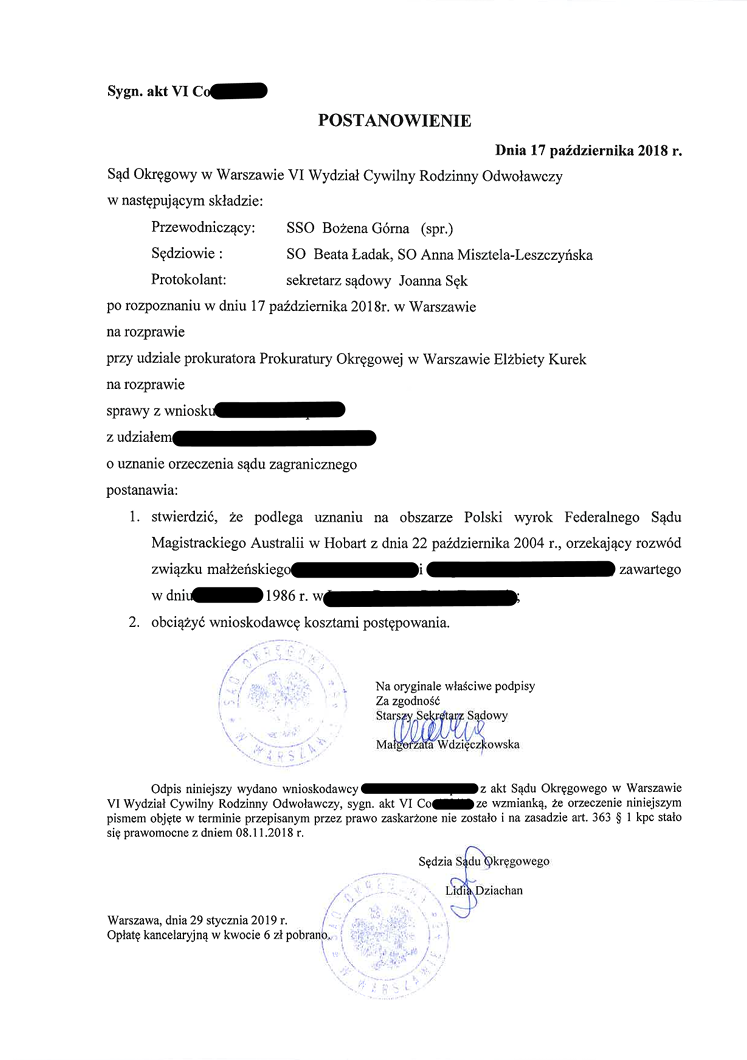
Divorces Granted Outside the European Union
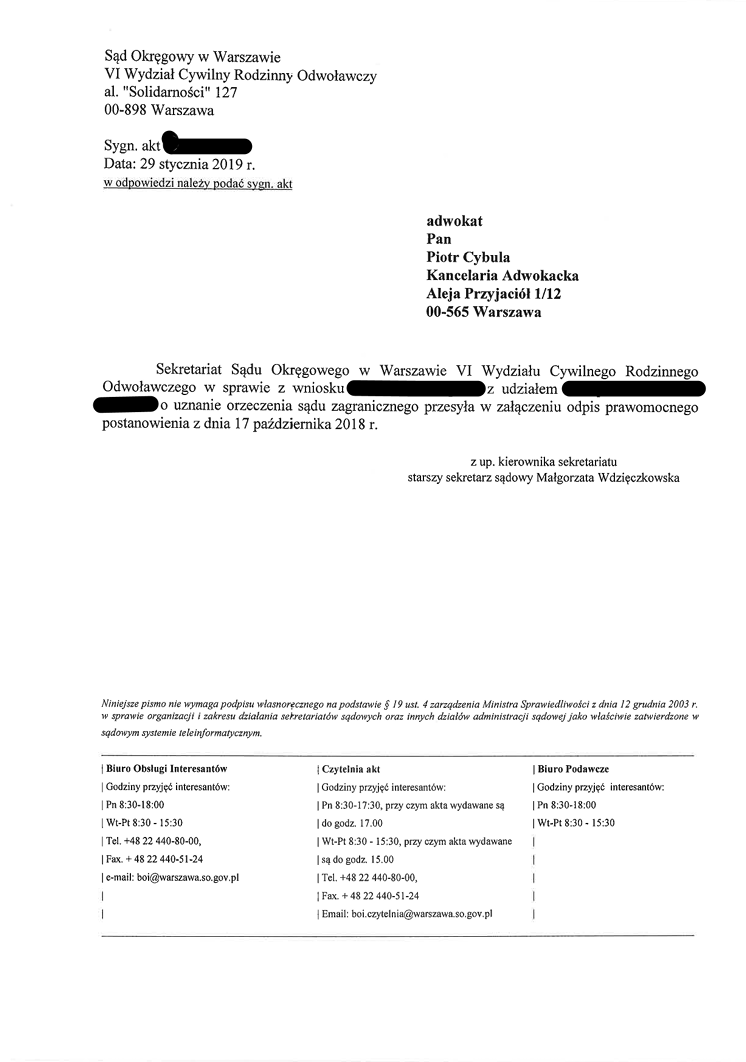
A significant number of the firm’s clients have obtained a divorce in the United States, Canada, Australia, Israel, the United Kingdom, or other countries outside the European Union.
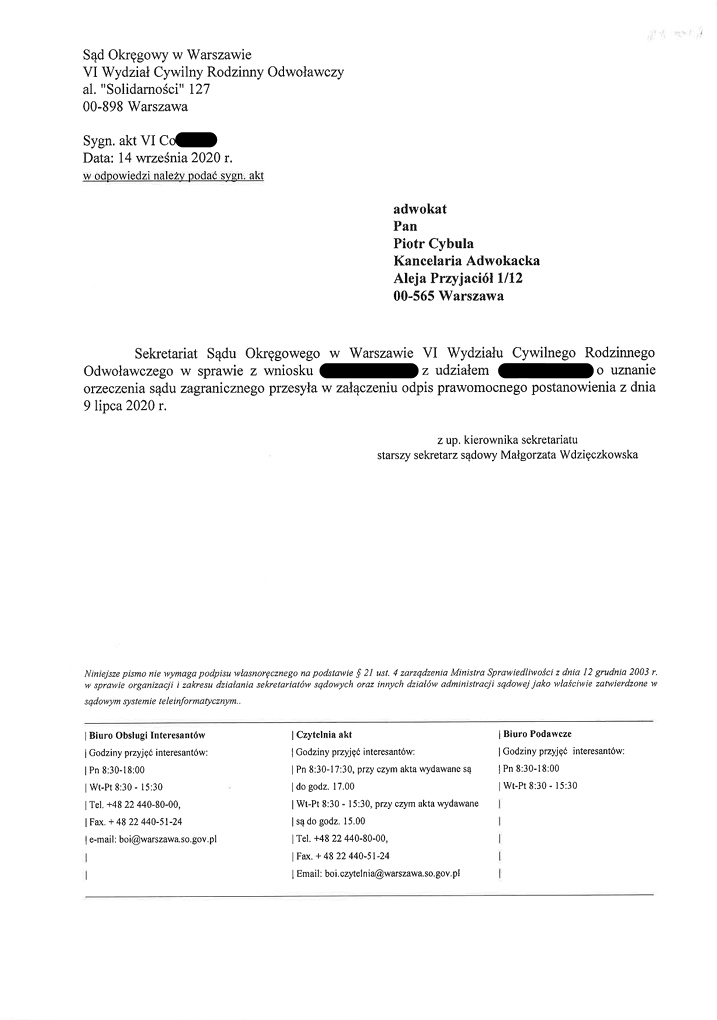
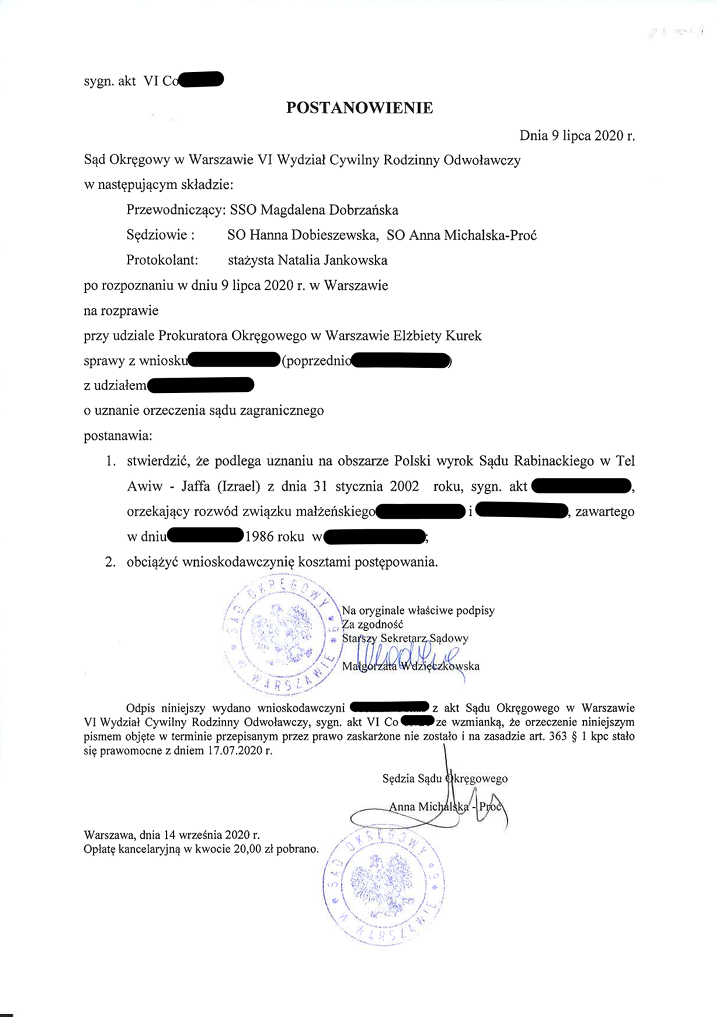
In such cases, the date the judgment was issued and the type of documentation available are of paramount importance. Depending on the circumstances, the case may require court proceedings or may be handled through a simplified procedure.
In practice, we very often encounter situations in which a client has only part of the divorce documentation, does not have a document confirming that the judgment is final and binding, or has not been in contact with their former spouse for many years. This does not preclude the possibility of successfully handling the case, but it does require a proper determination of how to proceed.
The Most Common Practical Problems
In cases involving the registration of foreign divorces, we most frequently encounter the following problems:
• lack of a document confirming that the judgment is final and binding;
• lack of an apostille or legalization;
• loss of part of the divorce documentation;
• discrepancies between the information contained in the judgment and the information recorded in Polish civil registry records;
• incorrect translations of documents;
• refusal by the Civil Registry Office to make the entry.
Assistance from Our Law Firm
Our law firm handles cases involving the registration of foreign divorces before both Civil Registry Offices and district courts. We represent clients residing in Poland and abroad, assisting them in determining the appropriate procedure and compiling the documentation required to successfully conclude the case.
Before accepting a case, we analyze the documents and determine what steps will be necessary in the specific situation. This allows us to avoid many formal issues and identify the most effective course of action from the very beginning.